
“Ultra-Minimally Invasive Carpal Tunnel Release” or Ultrasound-Guided Carpal Tunnel Release (USGCTR) is Now Available at The Gold Coast Carpal Tunnel Clinic. This surgery is based on extensive worldwide research. Numerous cadaver studies and clinical studies have proven the safety and efficacy of USGCTR, and one of our doctors has written a Systematic Review of the Subject as a research paper for his Master’s of Sports Medicine.
The technique used by our doctors is that described by Rojo-Manaute et al (Rojo-Manaute JMM et al. Ultra-Minimally Invasive Sonographically Guided Carpal Tunnel Release Anatomic Study of a New Technique. Journal of Ultrasound in Medicine 2013;32(1):131–142). This group first undertook a cadaver study in 2013, where they tested the technique and also very accurately described the “SAFE ZONE” for Ultrasound Guided Carpal Tunnel Release (USGCTR) using Ultrasound and MRI Scans.

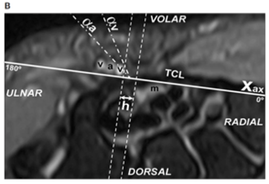
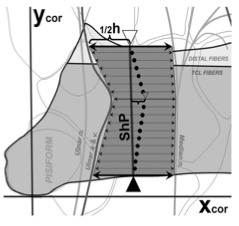
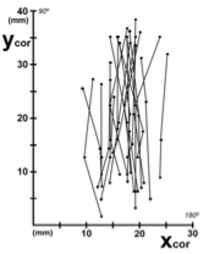
Based on their research, Rojo-Manaute et al. determined where it was safe to cut the transverse carpal ligament in an axial and coronal plane. Using a 3mm “Hook Knife,” the authors showed that all transverse carpal ligaments were completely divided, and no nerves, vessels, or tendons were injured in 10 cadaver specimens.
In 2014, the same group published another study under Capa-Grasa et al 2014 (Capa-Grasa A, Rojo-Manaute JM, Rodriguez FC, Martín JV. Ultra minimally invasive sonographically guided carpal tunnel release: an external pilot study. Orthop Traumatol Surg Res 2014; 100:287 292). In this Pilot study, the authors assessed the feasibility of performing a randomised trial comparing a randomised-MIS CTR to a Mini-Open CTR. They compared 20 patients in each group and showed that the QuickDASH patient scores were significantly better in the Ultrasound Guided CTR group.
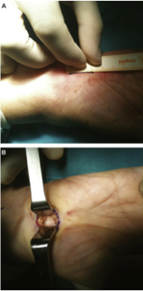
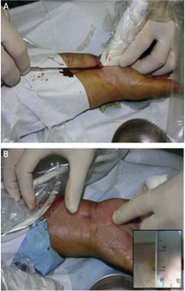
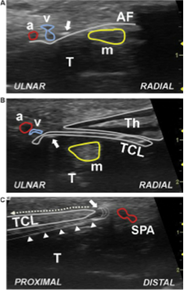
The group concluded that a prospective trial was needed; however, they stated:
“While a randomised trial is randomised for generalising its conclusions to our knowledge, there is currently no evidence to either contraindicate or withhold the use of Ultra-MIS in patients with symptomatic CTS and a positive electrodiagnostic test.”
Rojo-Manaute et al then published their “Landmark Paper” in 2016 (Rojo-Manaute JM et al. Ultra‐Minimally Invasive Ultrasound‐Guided Carpal Tunnel Release. Journal of Ultrasound in Medicine 2016;35(6):1149–1157), which is the most significant evidence to date validating the Ultrasound Guided Carpal Tunnel Release technique. The authors described the study as a “Single-centre individual parallel-group controlled-superiority randomised controlled study, The authors compared Ultra-Minimally Invasive CTR using a “Hook Knife” through a 1mm incision to Mini-Open CTR through a 2cm wound in the palm.
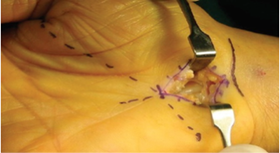
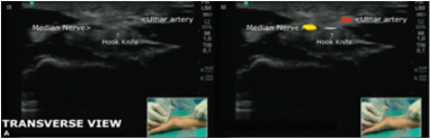
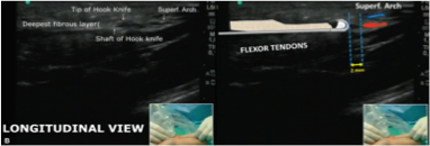
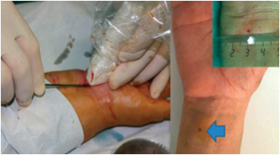
There were 92 patients in the study. Assessors were independent and blinded to the treatments by covering the wounds at examination. Treatments were randomised via a computer-generated list. Two groups, n=46, with 5 lost to follow-up per group, left 41 in each group, giving 82 patients matched to age, symptom duration, work type, pre-op treatment and sex.
QuickDASH scores were 2.3 to 3.3 times lower in the Ultra-MIS CTR group for the first 6 months. These results were statistically significant (t test, x2 test p<0.05).
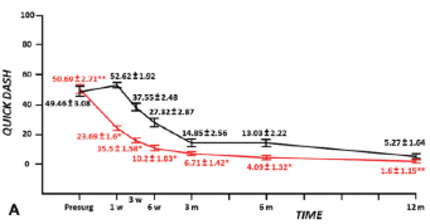
The authors concluded that Ultra-Minimally Invasive CTR produced less postoperative morbidity and earlier return of function compared to Mini Open CTR. Both procedures offered similar neurologic recovery for the treatment of carpal tunnel syndrome.
This study was the first Randomised Controlled Trial (RCT) to compare actual Ultrasound Guided Carpal Tunnel release (USGCTR) to any other established surgical treatment for CTS and the first real Level 1 Evidence for this procedure.
Based on the above research and other factors, our clinic has transitioned from Endoscopic Carpal Tunnel Release (ECTR) to Ultrasound-Guided Carpal Tunnel Release (USGCTR). Our doctors now offer Ultrasound-Guided Carpal Tunnel Release to our patients if they feel it is appropriate. Some cases of carpal tunnel syndrome still require open surgery. We still offer Endoscopic Carpal Tunnel release if patients request this technique; however, we will educate them about the benefits of ultrasound-guided CTR Surgery, and most patients proceed with the Ultrasound Guided technique