
FAQ

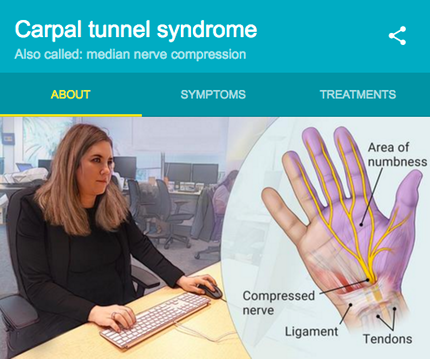
The carpal tunnel is a passageway in the wrist formed by eight carpal (wrist) bones, which make up the floor and sides of the tunnel and the transverse carpal ligament, a strong ligament stretching across the tunnel’s roof. Running through the carpal tunnel is the median nerve, which supplies sensation to the thumb, index, middle finger and usually half of the ring finger.
Carpal tunnel syndrome is caused by increased pressure in the carpal tunnel, which results in compression of the median nerve or narrowing of the tunnel from wrist injuries, inflammation, or arthritis. The actual injury to the nerve is usually caused by a lack of blood flow to the nerve.
Click on the link to learn more about what we can do for Carpal Tunnel Syndrome.
The most common symptoms are numbness, burning, and/or tingling of one or more fingers. These symptoms often first occur at night and can wake a person from their sleep. Aching, burning, and/or electric pain may extend into the fingers and up the arm to the elbow.
Certain activities, such as gripping, using a telephone, or holding a steering wheel while driving, can often aggravate the symptoms of carpal tunnel syndrome. In severe cases, clumsiness or weakness can occur. Other symptoms can include difficulty pressing buttons or picking up small objects.
For severe cases of carpal tunnel syndrome, a surgical approach will likely be recommended. Most people with carpal tunnel syndrome eventually require surgery. For mild cases, a conservative treatment approach can be taken, which usually involves splinting and avoiding activities that provoke symptoms. Sometimes, corticosteroid injections may be helpful in relieving symptoms.
Here at the Carpal Tunnel Clinic Gold Coast, our doctors perform the surgery under local anaesthetic using ultrasound guidance. The procedure is called Ultrasound-Guided Carpal Tunnel Release (USGCTR), or ultra-minimally invasive carpal tunnel release.
Ultrasound-guided carpal Tunnel Release (USGCTR) is performed as an outpatient procedure (meaning it is done in a non-hospital setting) under local anaesthesia. A tiny 1 – 2mm puncture wound is made above the palm, and the doctor cuts (releases) the transverse carpal ligament. This relieves the pressure on the median nerve. To watch a video of the procedure, click here.
No sutures or stitches are required for the USGCTR procedure. A Steri-Strip and Band-Aid are used to cover the puncture hole. You will require a wrist bandage overnight, which can be removed the day after surgery. Usually, the wound is completely healed within three days, and you can bathe as usual if the puncture wound is sealed and dry. It is unlikely that strong painkillers will be required after ultrasound-guided carpal Tunnel Release surgery. Occasionally, Panadeine Forte may be prescribed for the first night following surgery.
Our doctors will review you approximately one to two weeks after the surgery. Nerve conduction studies may be done again between two and six months after the surgery. These nerve conduction studies are bulk billed, meaning there is no additional charge for them. They are performed after the surgery to confirm that the nerve is recovering.

Post-operative pain is usually fairly minimal and controlled by simple analgesics such as Panadol and Nurofen. Occasionally, patients may require something more substantial, such as Panadeine Forte, for the first night.
The local anaesthetic may last for approximately 8 – 24 hours. Once it wears off, please contact the clinic if you need something stronger.
The success rate depends on the severity of the disease. If it is mild or moderate, the success rate is extremely high. In severe carpal tunnel syndrome, the prognosis is less predictable. Using the USGCTR technique, you rarely require revision surgery. In severe carpal tunnel syndrome, our doctors may use PRP or platelet-rich plasma Therapy to help the nerve recover.
All surgeries at The Carpal Tunnel Clinic Gold Coast are performed without general anaesthetic or sedation. This allows a much faster turnaround; most patients are in and out within one to two hours.
You can start using your hand the day after the surgery. The incision will be above the palm and will be covered with a dressing following surgery. For the first night, you will also have a bandage wrapped around the hand and wrist. After the first day, the bandage can be removed; however, we recommend keeping the dressing intact and dry for two days while the wound is healing. Please be aware that the dressing is water resistant but not waterproof, so you should not submerge the wrist in water for at least three days.
Grip strength will be slightly diminished because we are cutting the ligament that attaches to the thumb and little finger muscles. Grip strength loss is variable, but it usually recovers fully over three to four months once the ligament has healed. Some patients experience palm pain (pain in the base of the palm), which usually subsides within three to four months but can take up to 12 months to resolve fully.
In the case of ultrasound-guided carpal tunnel release (USG CTR), some patients may be able to drive within a few days. However, it’s still crucial to consult our doctors for personalised advice.
After open carpal tunnel surgery, it typically takes 2-3 weeks to drive again, though this can vary. While some individuals may be able to drive sooner (around a week) with endoscopic surgery, open surgery generally involves a more extended recovery period. The primary factors are pain levels and hand strength, which must be sufficient for safe vehicle control.
Return to work depends on your occupation. Non-manual workers, such as administration staff, may be able to return to work within days after the surgery. Heavy manual workers, however, may not be able to return to work for several weeks and may need to be on restricted duties.
You will need to discuss this further with your doctor.
If you would like to arrange an appointment with our doctors, you will need a GP referral so you are eligible for the Medicare rebates. Your GP can fax your referral to us at (07) 5531 3122, or you can email it to us at info@maguireupperlimb.com.au or info@thegcctc.com.au.
Once we receive your referral, our doctors will review it and determine if you need any further nerve conduction studies or X-rays performed before your appointment. If you have already had nerve conduction studies conducted in the past, but they are over three months old, these may need to be repeated.
One of our friendly receptionists will then call you to discuss your referral and help arrange any required tests, such as X-rays and nerve conduction studies. These tests are usually bulk-billed, meaning you should not have any out-of-pocket costs for these additional tests if you have a Medicare card.
No, a GP referral is unnecessary to see Dr Pearce and allow access to Medicare benefits and the Medicare Safety Net.